
Short answer: probably not even one day, and definitely not as long as you think. If your registration expired yesterday and you’re hoping there’s some grace period that lets you keep driving legally for a week or a month, I have to be the one to tell you — that’s not how it usually works, and the sooner you understand your state’s actual rules, the less this is going to cost you.
I’ve dealt with expired registration on three different vehicles across two states, once because I genuinely forgot and once because a renewal notice got lost in the mail during a move. Neither time did “I didn’t know” save me from a ticket. So let’s get into what actually happens, what the real risks are, and exactly how to fix it.
Is There a Grace Period for Expired Registration?
Some states do build in a grace period — a set number of days after your registration expires where you technically won’t get cited for the expiration itself. Other states have zero tolerance: the day after expiration, you’re driving illegally, full stop.
Here’s the part people get wrong: even in states with a grace period, that grace period is usually meant to cover administrative delays, not to give you a free pass to keep driving indefinitely. It often only protects you from a citation for the expired sticker/tag itself — it doesn’t mean you’re exempt from other consequences, and it doesn’t always apply the same way to registration renewal versus emissions/inspection deadlines, which can run on separate clocks.
Because this varies so much — some states have no grace period, some have a few days, some have a longer window tied to a mailed renewal notice — you need your specific state’s rule, not a guess. Here’s how to find it fast:
- Search “[your state] DMV registration grace period” or go straight to your state’s DMV/BMV/Secretary of State site.
- Look for the vehicle registration or renewal section — grace period info is usually listed right alongside late fees.
- If you can’t find it online, call your local DMV office directly and ask specifically: “Is there a grace period after registration expires, and how many days is it?”
- Check whether your state ties the grace period to a mailed renewal notice (meaning it only applies if you didn’t receive one) — this trips people up constantly.
Don’t assume the grace period you read about in a random forum post applies to you. State rules change, and drivers in comment sections are often wrong or out of date. Verify with your current, actual state DMV page.
What Actually Happens If You Drive With Expired Registration

Let’s break this into what can realistically happen, roughly in order of likelihood.
You get pulled over and cited
This is the most common consequence. An officer runs your plate or notices an expired sticker on your windshield or plate, and you get a citation. Depending on the state, this might be classified as an infraction, a moving violation, or even a misdemeanor if it’s been expired a long time. The fine amount varies enormously by state and even by county, so I won’t guess a number here — check your state’s traffic violation fee schedule, usually found on your state courts website or DMV site, to see what your jurisdiction actually charges.
Your vehicle can be impounded or towed
This is less common for a registration that’s only slightly expired, but it becomes a real risk the longer it goes. Some states authorize officers to have a vehicle towed if the registration has been expired past a certain threshold — often measured in months, not days. If your car gets towed, you’re now paying towing fees and storage fees on top of the registration renewal and any fines, and storage fees add up daily. This is the scenario that turns a $50 problem into a $500 problem fast.
Insurance complications after an accident
Here’s one people don’t think about until it’s too late: if you’re in an accident while driving with expired registration, your insurance company may still cover the claim, but it can also flag the lapse, and depending on your policy and state, it can complicate liability determinations or become a factor insurers weigh in future underwriting. This isn’t automatic denial of coverage in most cases, but it’s one more headache layered onto an already bad day. Don’t count on your insurance to make an expired registration a non-issue.
Registration suspension or points against your license
Repeated citations, or letting it go long enough, can in some states result in escalating consequences beyond just a fine — like registration suspension, additional penalties for repeat offenses, or referral to collections if fines go unpaid. This is state-specific and worth checking directly if you’re already past due by a significant amount.
You get flagged during any other stop or interaction
Traffic cameras, parking enforcement scanning plates, or even a stop for an unrelated reason (a broken taillight, rolling stop) can surface the expired registration even if that wasn’t why you were pulled over. Once it’s flagged, you’re getting the citation regardless of the original reason for the stop.
Why People End Up Driving on Expired Registration in the First Place
It’s rarely defiance. Most of the time it’s one of these:
- The renewal notice went to an old address after a move.
- Life got busy and the reminder email got buried.
- The registration is tied to an inspection or emissions test that hasn’t been completed yet, so renewal is stuck in limbo.
- There’s an outstanding issue — unpaid parking tickets, a lien, a lapsed insurance policy — blocking the renewal until it’s resolved.
- Money’s tight and the renewal fee got pushed off “for a few more days” that turned into weeks.
If any of these sound like you, the fix is almost always more straightforward than people expect. Let’s walk through it.
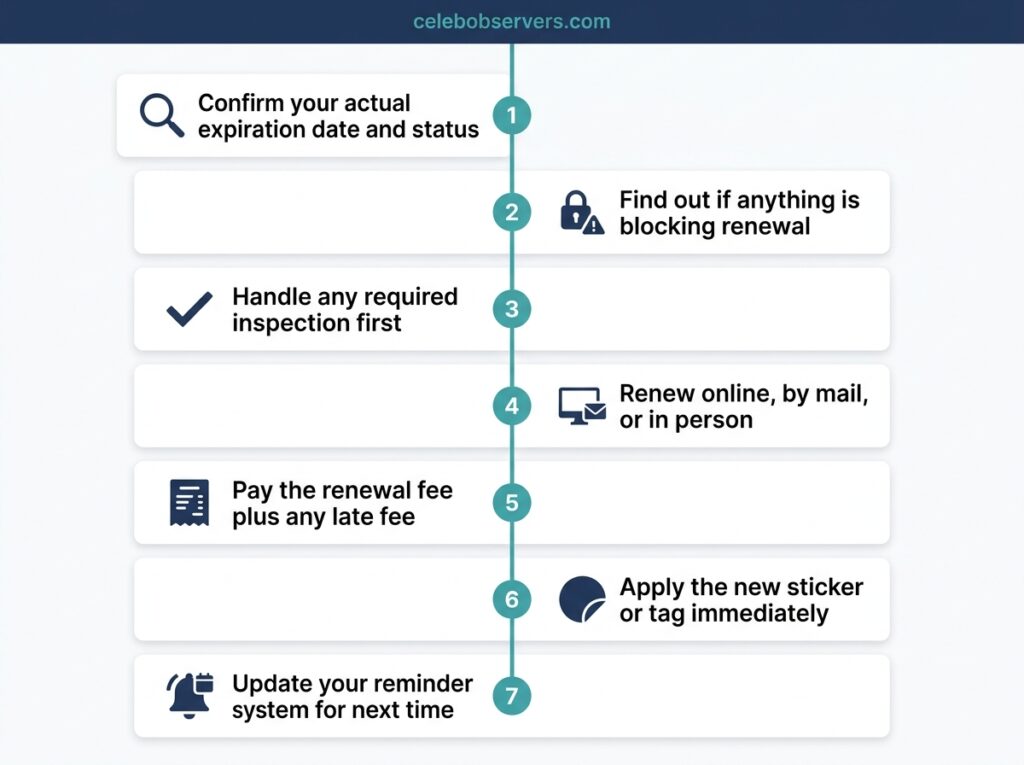
Step-by-Step: How to Fix Expired Registration

This is the general process across most states. Some steps may not apply to yours, and some states may have additional requirements (like a safety inspection or VIN verification), so treat this as the framework and confirm the specifics with your DMV.
Step 1: Confirm your actual expiration date and current status. Log into your state’s online DMV portal (most states have one now) or check the sticker on your plate/windshield. Some states let you look up registration status by plate number or VIN online, which is the fastest way to confirm exactly where you stand before doing anything else.
Step 2: Find out if anything is blocking renewal. Before you pay anything, check whether there’s a hold on your registration — unpaid tolls, parking tickets, a failed or missing emissions/inspection result, a lapsed insurance policy on file, or an unresolved recall. Most state DMV portals will show holds directly when you attempt to renew online. If there’s a hold, you’ll need to resolve that first, or the renewal will bounce.
Step 3: Handle any required inspection first. If your state requires an emissions test or a safety inspection as part of renewal, get that done before you try to renew — many portals won’t let the transaction go through without a passing result already on file.
Step 4: Renew online, by mail, or in person. Most states offer online renewal if there are no holds and your vehicle doesn’t need an in-person inspection. Online is almost always fastest. If you need something handled in person — plates, a title issue, a required document check — you’ll need to go to a DMV office or an authorized third-party registration agent (some states, like California with its registration collaborators, or Illinois with currency exchanges, allow this).
Step 5: Pay the renewal fee plus any late fee or reinstatement fee. Almost every state tacks on a late fee once you’re past the expiration or grace period, and some add a separate reinstatement fee if the registration lapsed long enough to be suspended rather than just “expired.” The exact amounts differ by state and sometimes by vehicle type or county, so check your DMV’s fee schedule directly rather than assuming a flat number.
Step 6: Get your new sticker, tag, or card and put it on the vehicle immediately. Don’t let it sit in your glovebox or a kitchen drawer. Put the sticker on the plate or windshield as soon as you get it — an unapplied sticker doesn’t protect you if you get pulled over.
Step 7: Update your reminder system for next time. Set a calendar reminder 30-45 days before your next expiration, and double-check your mailing address is current with the DMV, especially if you’ve moved recently. This single habit prevents 90% of repeat expired-registration situations.
What If You Need to Drive Before It’s Renewed?
Sometimes you’re stuck — you need to drive to work, or to the DMV itself, before you can get the registration sorted. A few honest options:
- Check if your state issues temporary permits. Many states will issue a temporary operating permit or temporary tag while you sort out a title issue, inspection, or documentation problem, especially if the delay isn’t your fault (like a lost renewal notice or a DMV processing backlog). Ask your DMV directly if this applies to your situation.
- Try to complete the renewal online same-day. If the only issue is that you forgot, and there’s no hold, you can often renew online in minutes and at least have proof of renewal even before the physical sticker arrives. Some states let you print a temporary proof-of-registration document immediately after online renewal — worth checking.
- Avoid driving if you can. If it’s genuinely optional — you can get a ride, delay the errand a day, or work remotely — that’s the lowest-risk move while you sort out any holds.
I’ll be straight with you: there’s no scenario where “I’ll just drive carefully and hope I don’t get pulled over” is actual legal advice. It’s a bet, and it’s one you might lose at the worst possible time — say, during an accident that wasn’t even your fault, when you suddenly need every piece of paperwork in order.
Common Mistakes People Make
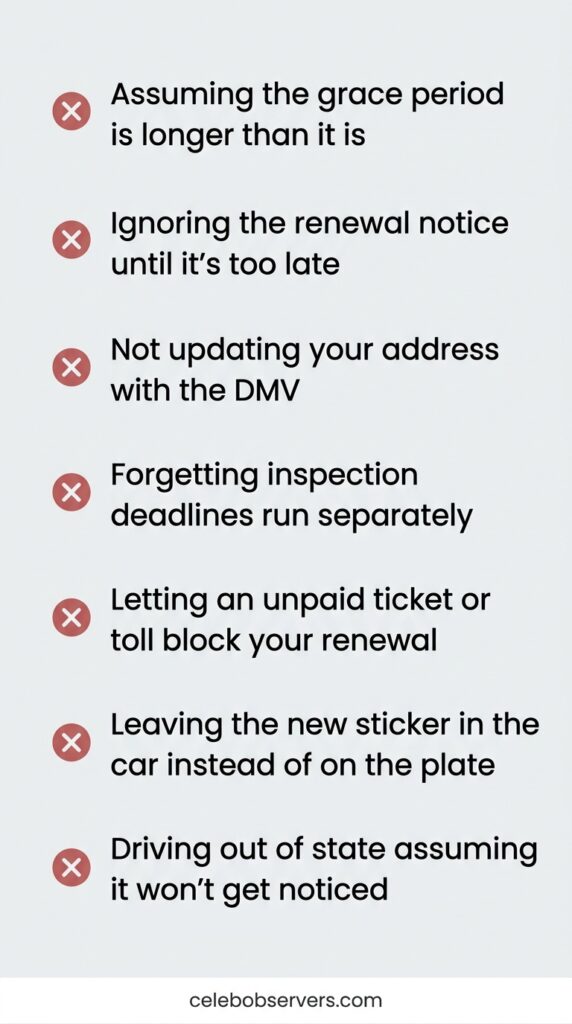
- Assuming the grace period is longer than it is, or assuming there is one at all. Verify it. Don’t guess based on what a friend’s state does.
- Ignoring a renewal notice because “I’ll get to it,” then losing track of the actual deadline. The notice date and the actual expiration date aren’t always the same thing — read it carefully.
- Not updating their address with the DMV after moving. This is probably the single biggest cause of “I never got the renewal notice.”
- Forgetting that inspection or emissions requirements run on their own clock. You can have a current registration sticker and still be technically non-compliant if a required inspection lapsed separately, depending on your state’s system.
- Letting a hold (unpaid ticket, toll, insurance lapse) sit unresolved, not realizing it’s silently blocking renewal. Check for holds before you assume renewal will be a quick, simple transaction.
- Putting the new sticker in the car instead of on the plate/windshield. An unapplied sticker gives you zero legal protection.
- Driving out of state with expired registration, assuming it’s “less likely to get noticed.” License plate readers and interstate data sharing make this a bad assumption.
- Waiting until the registration is suspended (not just expired) before acting, which often triggers a separate, more expensive reinstatement process on top of the normal renewal fee.
What It Costs and How Long It Takes

Every number below varies by state, county, and sometimes by vehicle type or weight class, so treat this as a framework for what to expect rather than a price list.
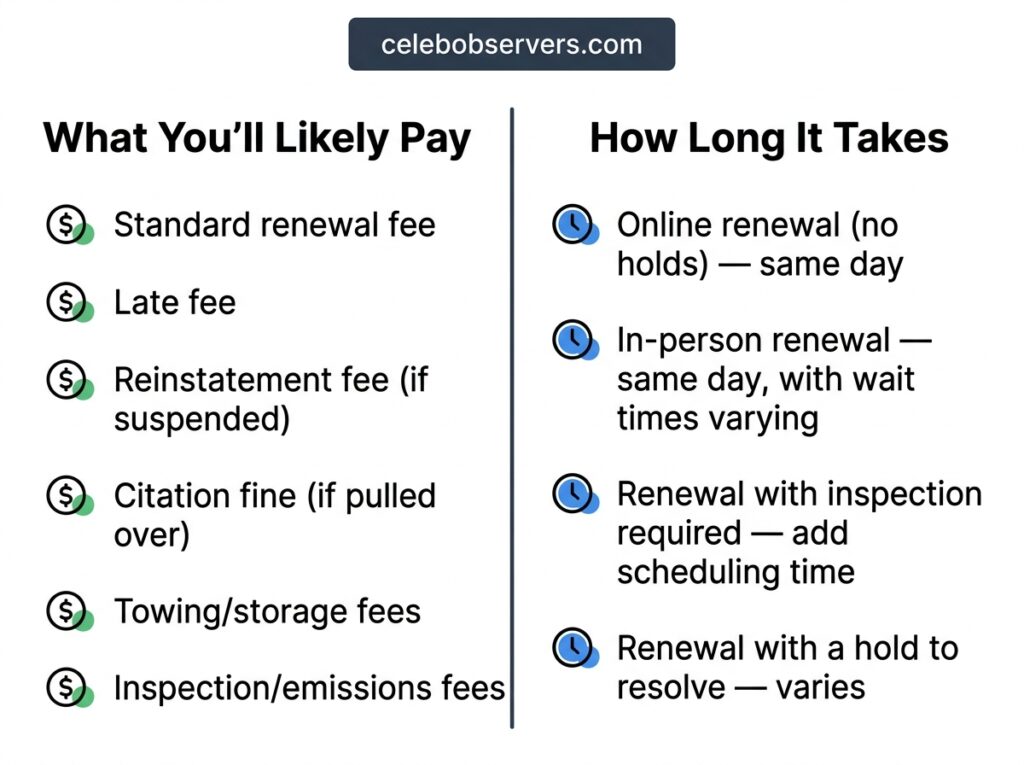
What you’ll likely pay:
- The standard renewal fee (varies by state, vehicle type, and sometimes vehicle age or weight).
- A late fee, which most states apply once you’re past the deadline or grace period — often a flat fee or a percentage, and sometimes it increases the longer you wait.
- A reinstatement fee if the registration lapsed long enough to be suspended, not just expired — this is usually separate from and in addition to the late fee.
- Any citation fine if you were actually pulled over and cited before you renewed.
- Towing and storage fees if it came to that, which can accumulate daily and get expensive fast.
- Inspection or emissions testing fees if required and not already current.
To get your actual numbers, go to your state DMV’s fee schedule page (search “[your state] DMV registration fees”) or call your local office. Fee schedules are public information and usually posted online.
How long it takes:
- Online renewal with no holds: often same-day, sometimes instant, with the physical sticker/card arriving by mail within a couple weeks.
- In-person renewal: typically same-day, though wait times at DMV offices vary widely — some states let you book an appointment online, which is worth doing if your office has long lines.
- Renewal with an inspection requirement: add the time to schedule and complete the inspection, which can be same-day at many inspection stations or take longer if you need an appointment.
- Renewal with a hold to resolve (unpaid tickets, insurance lapse verification, etc.): this is the wildcard — could be resolved in a day, could take longer if it involves another agency like a court or your insurer confirming coverage.
If you’re already past due and stressed about it, the fastest path forward is almost always: check for holds first, resolve any you find, then renew online if your state allows it. Skipping straight to “just show up at the DMV” without checking for holds first is how people end up making two trips.
The Bottom Line
There’s no safe number of days you can drive on expired registration — treat it as zero. Some states technically build in a short grace window, but relying on it is a bet, not a plan, and it doesn’t protect you from every consequence even where it exists. The real fix takes less effort than most people assume: confirm your status, check for holds, handle any required inspection, renew online or in person, and put the new sticker on immediately. Set a reminder for next time so you’re not back here in twelve months. If you’re in a bind and need to drive before it’s sorted, ask your DMV about a temporary permit rather than just hoping for the best — that one phone call can save you a citation, a tow, or worse.
FAQ
Does expired registration affect my insurance if I get in an accident?
It can complicate things even if it doesn’t automatically void your coverage. Your insurer may still process the claim, but the lapse can become a factor in liability discussions or future underwriting. Check your specific policy terms and consider calling your insurer directly if you’re driving on expired registration and want to understand your exact exposure.
Can I get pulled over just for expired registration, or does it have to be part of another stop?
Officers can and do stop or cite vehicles specifically for an expired registration sticker or plate, separate from any other violation. It doesn’t need to be tied to another infraction — an officer running your plate or spotting an expired tag is enough in most states.
What if I never received my renewal notice in the mail?
Some states will consider this when applying grace periods or waiving certain late fees, but you generally have to proactively raise it with the DMV rather than assume it’s automatically excused. Update your address with the DMV as soon as possible and ask directly whether a missed notice affects any fees you’re being charged.
Is it different if my registration is expired versus suspended?
Yes, and this trips a lot of people up. Expired usually just means the renewal period passed. Suspended is a more serious status, often triggered by an unresolved issue (unpaid fines, insurance lapse, failed inspection) or by letting the expiration go on long enough. Suspended registration typically requires a separate reinstatement process and fee on top of the standard renewal, so check your DMV portal to see which status actually applies to your vehicle before you assume it’s a simple renewal.