
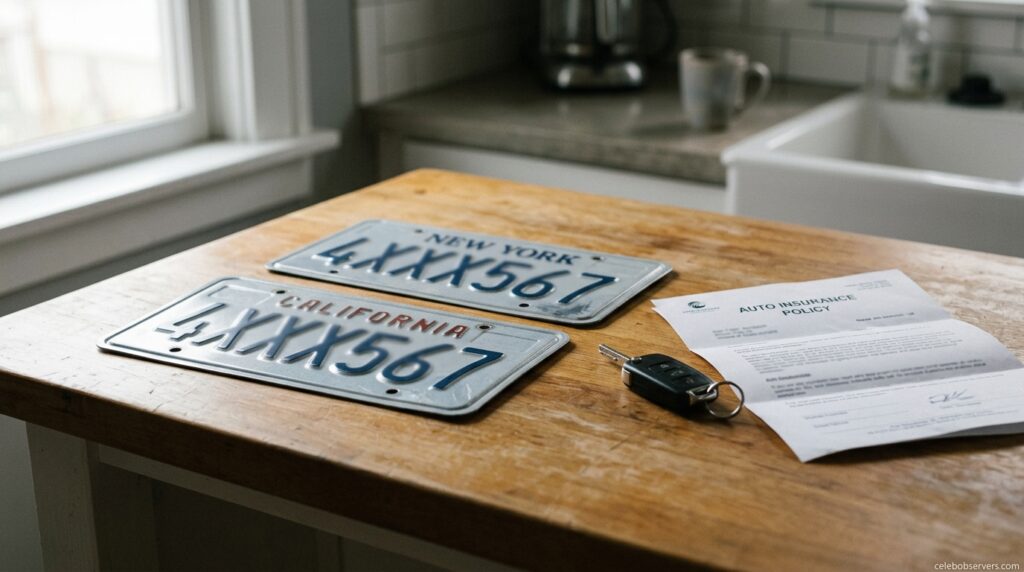
You sold the car. Or it got totaled. Or you moved to a state that does things differently, and now there’s a pair of plates sitting on your kitchen counter and you’re wondering what happens if you just… don’t do anything. Short answer: doing nothing is the mistake that costs people money. Insurance companies and DMVs talk to each other more than you’d think, and an unreturned plate can quietly generate registration renewal notices, insurance requirement flags, or even liability questions tied to a vehicle you no longer own.
I’ve surrendered plates in a few different states over the years — once after totaling a car in a highway accident, once after a straightforward private-party sale, once after moving cross-country and needing to swap everything over. The paperwork logic is different everywhere. The underlying goal isn’t: you’re telling your state, officially, “this plate is no longer active, and I’m not responsible for whatever happens under it going forward.”
This guide covers why surrendering matters, exactly how to do it, what trips people up, and what it actually costs in time and money.
Why You Need to Surrender Plates in the First Place

A license plate isn’t really “yours.” In most states it’s tied to your registration record, and in some states it’s tied to the vehicle, not the person. Either way, until you formally close that record out, the state often assumes the plate is still active and the vehicle is still yours.
That matters for a few concrete reasons:
Insurance. Many states electronically link registration to proof of insurance. If you cancel your auto policy on a car you sold but never surrendered the plate, some states will flag that as a lapse in required coverage — and fine you for it — even though you no longer own the car.
Registration renewals. Nobody wants a renewal notice, and a renewal fee, for a car sitting in someone else’s driveway three states away.
Liability and tickets. Rarer, but it happens: red light camera tickets, parking tickets, or toll charges from a new owner can occasionally trace back to you if the registration record wasn’t properly closed and the new owner didn’t retitle promptly. Surrendering the plate cuts that connection at the source.
Personalized or specialty plates. If you paid extra for a vanity plate or a specialty design, some states let you either transfer it to a new vehicle or bank the reservation for future use. But only if you surrender it correctly instead of letting it disappear with the car.
Surrendering the plate closes the loop. It’s the DMV equivalent of changing your address — technically optional in the sense that nobody frog-marches you to do it, but skipping it tends to bite you later.
When You Actually Need to Surrender Your Plates
Not every situation requires a plate surrender, and this is where people get confused. Generally, you’ll need to surrender plates when:
- You sold or gave away the vehicle and aren’t transferring the plate to a replacement vehicle
- The vehicle was totaled, junked, or scrapped
- You moved to a new state and are registering there instead
- You’re canceling insurance on the vehicle and not replacing it right away
- The vehicle was repossessed
- You’re putting the vehicle into long-term storage in a state that doesn’t allow non-renewal without surrender
- You inherited a vehicle and are handling the estate, and the plate isn’t staying with the car
You generally do not need to surrender plates if you’re keeping the vehicle and just letting registration lapse temporarily in a state that allows that. Some do, some don’t — this is exactly the kind of rule that varies, so check your state’s current policy before assuming. And you don’t need to if you’re transferring the same plate to a new vehicle you’re purchasing, since some states let residents keep their plate number across vehicles.
Where and How to Surrender License Plates: Step-by-Step
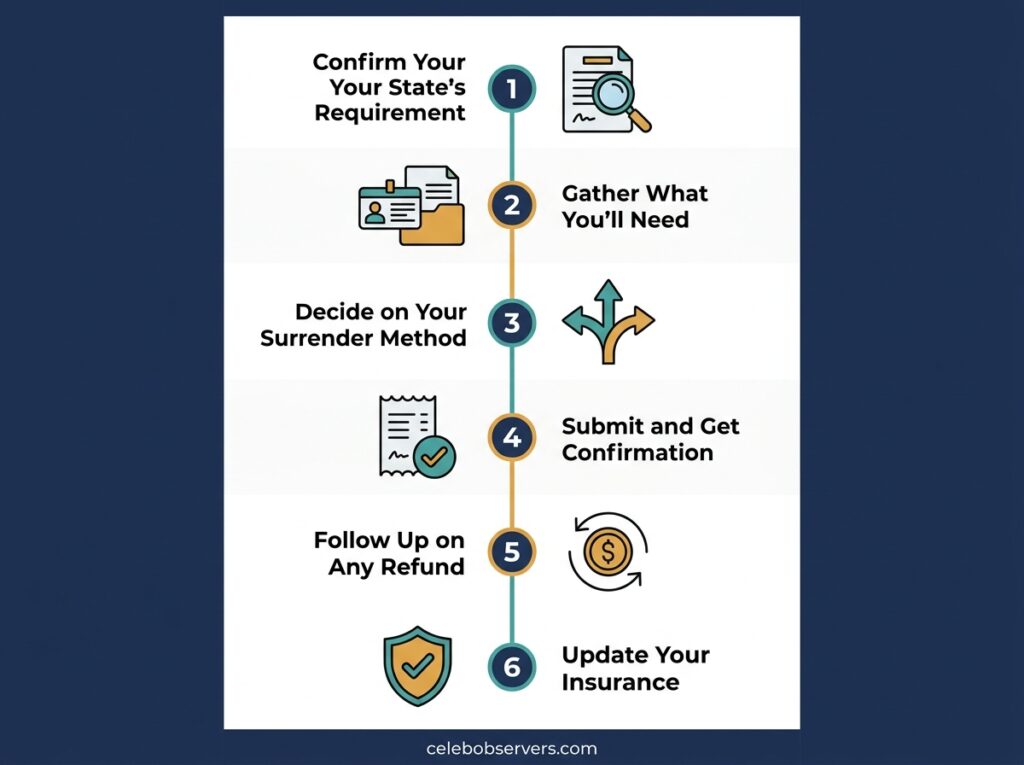
The exact mechanics vary by state, but the overall process follows a predictable shape.
Step 1: Confirm your state’s specific requirement
Pull up your state DMV’s (or equivalent agency’s) website and search for “surrender plates” or “return plates.” Some states use different names for the same motor vehicle agency — DMV, BMV, MVD, RMV, SOS office — so search using your state’s actual agency name if “DMV” doesn’t turn anything up. This matters because some states require in-person surrender, some allow mail, and a growing number allow it online or even process it automatically when you complete a related transaction, like a title transfer. Don’t assume. Verify for your state.
Step 2: Gather what you’ll need
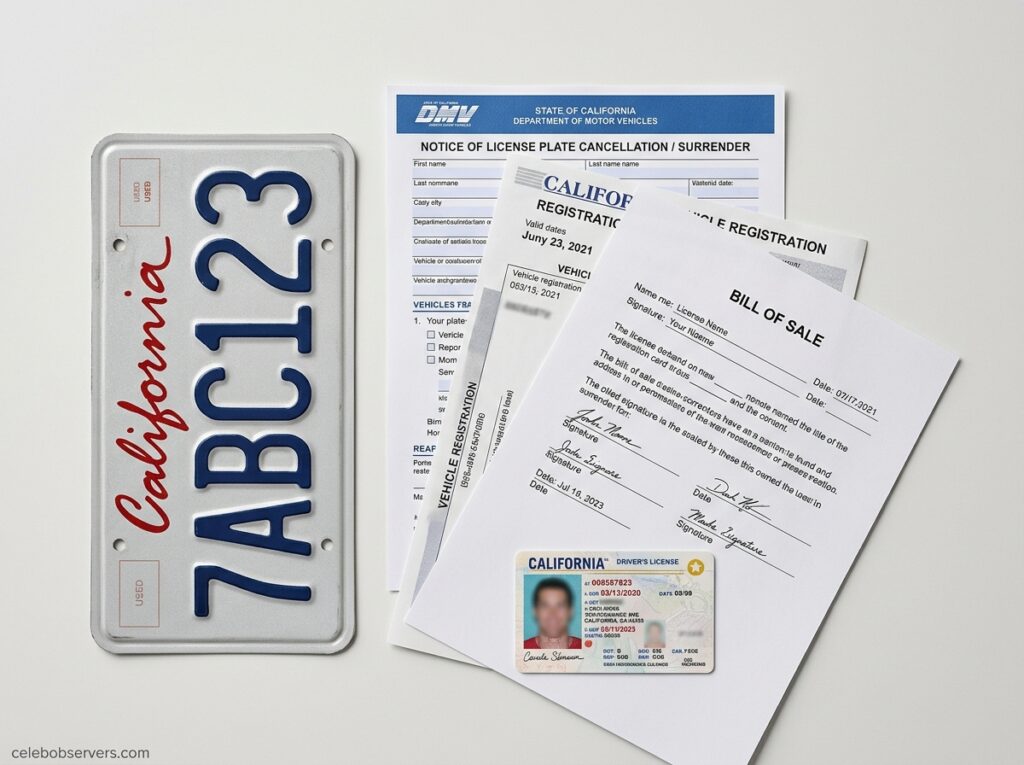
At minimum, expect to need:
- The physical plates themselves (both, if your state issues front and rear)
- Your driver’s license or state ID
- Proof of the reason for surrender if applicable — a bill of sale, an insurance settlement letter for a totaled car, a junk/salvage receipt, or your new state’s registration if you moved
- Your vehicle registration card, if you still have it
Some states also want a short form filled out explaining why you’re surrendering — sold, junked, moved, whatever applies. If your state has one, it’s usually a single page, downloadable from the DMV site.
Step 3: Decide on your surrender method
Depending on your state, you’ll have some combination of these options:
- In person at a DMV/BMV office — often the fastest way to get an immediate confirmation or receipt
- By mail — you send the plates and any required form to the address listed on your state’s DMV site
- Online — a growing number of states allow you to report a plate surrender digitally, though you may still need to physically destroy or turn in the plate separately
- Automatically through a related transaction — some states auto-cancel plate registration once you report a total loss through your insurer, or once you complete a title transfer
If you’re mailing plates, use a trackable shipping method. Seriously — I’ve heard from more than one person whose plates got “lost in the mail” according to a DMV that swore it never received them. A tracking number ends that argument instantly.
Step 4: Submit and get confirmation

This is the step people skip and regret. Whether you go in person, mail it, or do it online, get some kind of confirmation — a receipt, a confirmation number, an email, anything with a date on it. If a registration or insurance question ever comes up later, this is your proof that you closed things out on that date.
Step 5: Follow up on any refund you might be owed
If you paid for registration through a future date and you’re surrendering the plate early, some states issue a partial refund for the unused months. This isn’t universal, and where it exists, it’s often not automatic — you may need to specifically request it. Check your state’s rules on prorated registration refunds. Don’t assume it happens by default.
Step 6: Update your insurance
Once the plate is surrendered and the vehicle is no longer yours — sold, totaled, junked — call your insurer to remove that vehicle from your policy. Do this after you’ve confirmed the surrender, not before. You generally want proof the vehicle is off your registration before you drop coverage, especially in states with electronic insurance verification tied to plates.
Special Situations Worth Knowing About

Totaled or salvage vehicles
If your car was declared a total loss, your insurance company may handle part of this process for you, especially if they’re taking possession of the vehicle. Don’t assume they surrendered the plate on your behalf, though — confirm it directly with your DMV. In my experience, insurers are good about title paperwork and less consistent about plate surrender, since it’s not really their transaction to close.
Moving to a new state
When you move, you typically surrender your old state’s plate as part of registering your vehicle in the new state. But the order of operations matters, and it varies. Some states want you to register first and will handle the old plate as part of that process; others want the old plate returned or destroyed independently. Check both your old and new state’s rules, since one of them may have a specific process for out-of-state surrenders — sometimes by mail directly to your former state.
Selling a car privately
Some states let you keep your plate and move it to your next vehicle instead of surrendering it with the sale. If you want to do that, don’t hand your plates over to the buyer. Remove them before they drive off, and start the transfer or surrender process from there. Handing plates to a buyer is one of the most common and most avoidable mistakes in a private sale — and honestly, this is the one that trips people up more than anything else in this guide.
Deceased owner or estate situations
If you’re settling an estate that includes a vehicle, plate surrender is usually part of closing out the registration, separate from the title transfer to an heir or buyer. DMVs often have a specific process for this, sometimes requiring a death certificate copy or executor documentation. Call your state DMV directly here rather than guessing. Estate transactions are one area where a phone call saves real time.
Leased vehicles
If you’re returning a leased vehicle at the end of the term, check with the leasing company on plate handling. In some states, the plate stays with you and gets surrendered by you; in others, the dealership or leasing company handles it as part of the return. Ask before you drop the car off.
Common Mistakes People Make
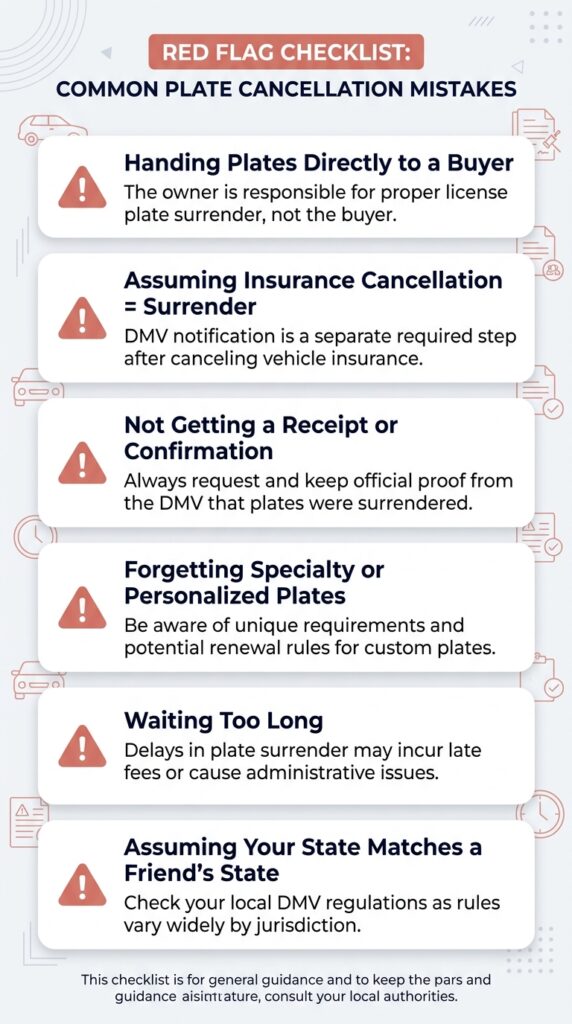
Handing plates directly to a buyer. This is the big one. In a lot of states, the plate is tied to you, not the car — handing it over means the buyer is now driving around on your registration, and any tickets, tolls, or accidents in that gap can trace back to you.
Assuming cancellation of insurance equals surrender. These are two separate systems that sometimes talk to each other and sometimes don’t. Don’t assume canceling your policy automatically flags your plate as surrendered with the DMV.
Not getting a receipt or confirmation. Mail plates in, or drop them off without documentation, and you’ve got nothing to point to if a renewal notice shows up eight months later.
Forgetting about specialty or personalized plates. These often have separate rules for holding, transferring, or reserving the plate design. If you paid extra for it, look into whether you can bank it before you surrender it. Some states will otherwise just retire it.
Waiting too long. Registration renewal notices, and in some cases fees, keep accruing until the plate is officially surrendered or expired. The sooner you close it out after selling or totaling the vehicle, the less cleanup you’ll have later.
Assuming your state’s rules match a friend’s state. Plate law is one of the more fragmented areas of DMV administration. What’s true in one state — mail-in surrender, no in-person requirement — can be completely different two states over, where an in-person surrender with the vehicle title is mandatory. Always check your specific state.
Not destroying plates when required. A few states require you to cut or deface plates if you’re not returning them physically — for example, if a plate was lost or damaged and you’re reporting it rather than returning it. If your state has this rule, follow it exactly. A plate that isn’t clearly destroyed can sometimes complicate a fraud or lost-plate report.
What It Costs and How Long It Takes
This genuinely depends on your state, so rather than throwing out a number that might be wrong for you, here’s how to find your real figures fast.
Cost. In most states, surrendering a plate itself is free. You’re not being charged to give something back. Where cost comes in is usually on the other side of the transaction: a new registration fee if you’re re-plating a different vehicle, a small administrative fee in some states for processing a refund on unused registration months, or fees tied to whatever triggered the surrender, like reissuing a title after a sale. To get your actual number, go to your state DMV’s fee schedule page — nearly every state publishes one — and search for “plate surrender,” “registration cancellation,” or “refund,” depending on which applies to your situation.
Time. In-person surrender is usually fastest. You can often walk out with confirmation the same day, though wait times at DMV offices vary wildly by location and time of year (end-of-month and post-holiday periods tend to be busier). Mail-in surrender depends entirely on postal transit time plus however long your state takes to process incoming mail — this can run anywhere from about a week to several weeks, so build in buffer time if you’re trying to close something out before a deadline like an insurance cancellation date. Online surrender, where available, is often fastest for the digital part of the process. But double-check whether your state still requires the physical plate to be mailed in or destroyed afterward. “Online surrender” doesn’t always mean fully online.
Refunds, if your state offers them for unused registration time, typically take longer than the surrender itself. Ask about the timeline specifically when you submit — they’re rarely instant.
One universal piece of advice: check your state DMV’s website for the current fee schedule and processing time estimates before you start. If anything seems unclear, call the office directly. Wait times on DMV phone lines are their own adventure, but a five-minute call can save you a wasted trip or a mailed form that comes back rejected for a missing signature.
A Quick Reference Checklist

Before you consider this done, make sure you’ve covered:
- [ ] Confirmed your state’s specific surrender method (in person, mail, online, or automatic)
- [ ] Gathered the plates, ID, and any required proof of sale/loss/move
- [ ] Filled out any required form
- [ ] Submitted through your chosen method with tracking or an in-person receipt
- [ ] Received and saved confirmation with a date
- [ ] Checked whether you’re owed a prorated refund
- [ ] Updated or canceled insurance on the vehicle
- [ ] Handled any specialty/personalized plate reservation, if applicable
The Bottom Line
Surrendering a plate isn’t complicated once you know your state’s specific process. It’s mostly a matter of not skipping it, not assuming another transaction handled it for you, and keeping proof that you did it. The people who run into trouble almost always fall into one of two camps: they handed plates to a buyer and got tied to someone else’s driving record, or they assumed insurance cancellation and plate surrender were the same thing. Avoid both. Get your written confirmation. You’re genuinely done — no lingering registration ghosts following you around months later.
FAQ
Do I get money back for surrendering my plates early?
Sometimes, if your state prorates registration refunds for unused months — but this isn’t universal and often isn’t automatic. Check your state DMV’s refund policy and ask specifically when you submit your surrender, since you may need to request it rather than receive it by default.
Can I just throw my old plates away instead of surrendering them?
You can physically dispose of them, but that doesn’t close out your registration record with the state. Skipping the official surrender step can leave your registration looking active, which risks renewal notices or insurance-related flags down the line. Complete the actual surrender process, even if you also plan to recycle or keep the physical plate as a keepsake.
What happens if I move states and don’t surrender my old plate?
Your old state may continue to show that plate and registration as active, which can generate renewal reminders or fees. Some states cross-reference new out-of-state registrations to catch this automatically, but not all do — don’t rely on that happening. Surrender or report the plate to your old state directly, following whatever process they list for out-of-state surrenders.
Can I keep my license plate as a souvenir?
In many states, yes. You can report the plate as surrendered without necessarily mailing in the physical item, especially if it’s a personalized plate you want to keep. Some states, though, specifically require the physical plate back or require you to deface it if you’re keeping it. Check your state’s rule before assuming you can hang onto it.