
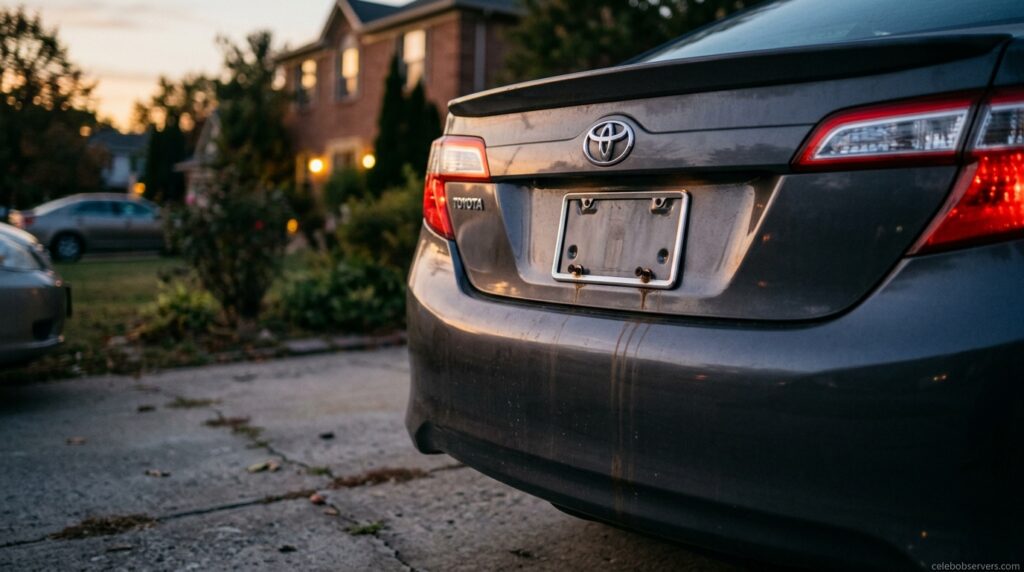
Your plate’s gone. Maybe it rattled off on the highway, maybe someone lifted it out of your driveway overnight, or maybe you’re just standing in your garage staring at an empty bracket wondering where the hell it went. Either way, you can’t legally drive without it, and you’re probably wondering if this is a five-minute fix or a multi-week headache. Honest answer: depends on why it’s missing. But the process is manageable if you handle it in the right order.
I’ve dealt with this exact situation twice — once when a plate rattled loose on a pothole-riddled stretch of interstate, and once when someone straight-up lifted a plate off my car in a parking garage. Yes, that happens. It’s more common than people think, usually so someone can slap it on another car to dodge tolls or parking tickets. The steps overlap a lot, but there are a few important forks in the road depending on your situation. Let’s walk through it.
First, Figure Out Why the Plate Is Missing

Before you call anyone or fill out anything, figure out which of these situations you’re actually in.
It fell off. A bracket rusted through, a screw backed out, or you hit something that knocked it loose. This is the most common scenario, especially with older vehicles or in states with harsh winters where road salt eats through mounting hardware.
It was stolen. Someone took it deliberately — pried it off, cut zip ties, whatever. That’s a different animal entirely. Stolen plates get used for fraud: unpaid tolls, red light camera tickets, sometimes worse. You need a police report for this one, not just a DMV form.
You genuinely lost it. It came off during a move, got left in a parking lot, or you just can’t find it and don’t know why. Treat this like the “it fell off” scenario for DMV purposes, but be aware — if it turns up being used somewhere, you’ll want documentation showing when you reported it missing.
Why does this distinction matter? A stolen plate creates liability exposure that a plate which simply fell off a bolt doesn’t. If your plate gets stolen and someone racks up toll violations or worse on it, you want a paper trail proving you reported it before those incidents happened. Skipping the police report because “it’s just a plate” is one of the more common mistakes I see people make.
Step-by-Step: What to Do Right Now
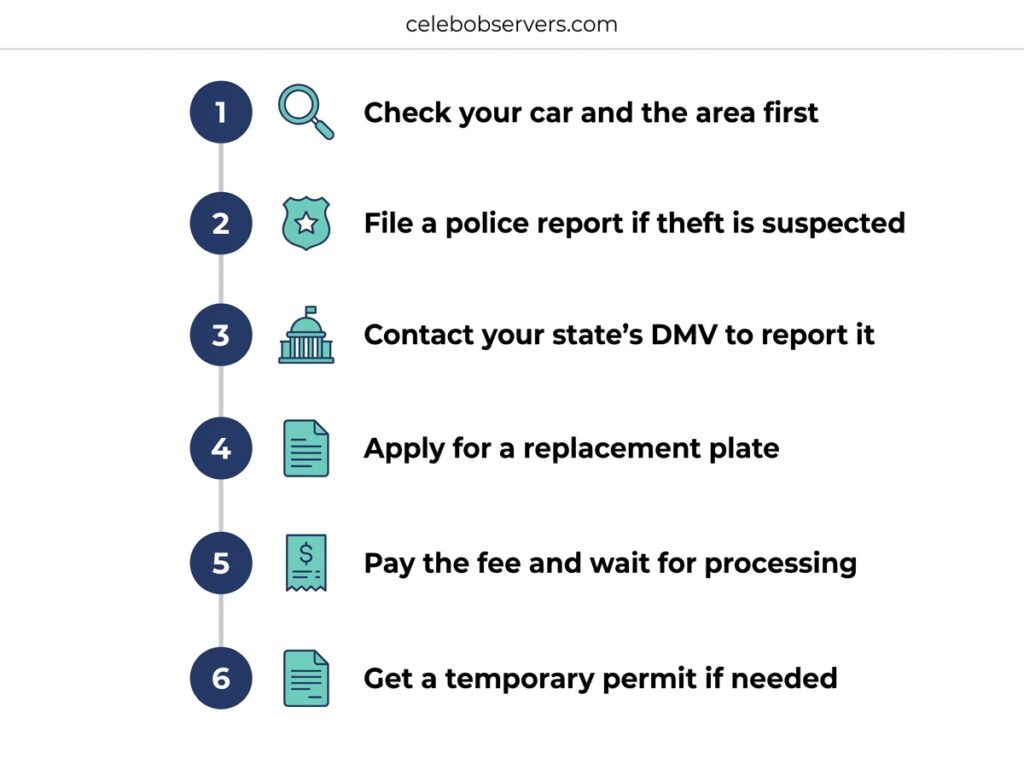
Here’s the actual sequence, in order, that gets you back on the road legally with minimum hassle.
Step 1: Check your car and the area first
Look before you assume it’s gone for good. If it fell off recently, it might be sitting on the roadside near where you last remember seeing it, or it could’ve fallen into your trunk, your garage, or wedged under the car itself. I’ve genuinely found a “lost” plate rattling around in a wheel well before. Takes two minutes. Saves you the whole process if you get lucky.
Step 2: File a police report if theft is suspected — or even if you’re not sure
If there’s any chance the plate was stolen rather than simply fell off, file a police report. Most departments let you do this online for non-emergency, no-suspect situations like this. Check your local police department’s website for a “file a report online” option — almost every mid-size to large department has moved routine plate theft reports to a self-service portal.
Not 100% sure it was stolen? File the report anyway. It costs you nothing and creates a timestamp. If that plate turns up on someone else’s car dodging tolls three weeks from now, you’ll be very glad you have it.
Step 3: Contact your state’s DMV to report the plate lost or stolen

This is the step people skip or delay, and it’s a mistake. Every state has a mechanism to flag a plate number as lost, stolen, or invalid in their system. That matters for a few reasons:
- It protects you from being blamed for violations committed by whoever ends up using that plate number
- It’s usually a required step before you can get a replacement
- Many states legally require you to report this within a certain window
The exact reporting method varies a lot by state. Some let you do this entirely online through the DMV portal, some require an in-person visit, some let you call. Search “[your state] DMV lost or stolen license plate” to find your state’s specific portal or form. Don’t guess based on what a friend in another state told you — DMV processes are notoriously state-specific, and what worked for your cousin in Ohio may not apply to you in Georgia.
Step 4: Apply for a replacement plate
Once you’ve reported the loss, you’ll need to apply for a replacement. This usually means one of two things:
- Replacing just the missing plate (if you had two plates and lost one, some states let you keep the matching plate and just reissue the missing one with the same number)
- Replacing both plates with a new set (some states require both plates to be reissued together, especially if the original pair can’t be verified as a matched set anymore)
Which applies to you depends entirely on your state’s rules. This is a case where you genuinely need to check your state DMV’s specific policy rather than assume. The application itself is typically a short form — look for something like “replacement plate application” on your DMV’s website. You’ll usually need:
- Your vehicle registration or title information
- Proof of identity
- The police report number, if you filed one
- Payment for the replacement fee
Step 5: Pay the fee and wait for processing
Fees and processing times vary widely by state, and by whether you’re getting standard plates or specialty/vanity plates re-issued. More on that below. Short version: expect to pay something, and expect a wait longer than you’d like if they’re mailing you a physical plate.
Step 6: Get a temporary permit if you need to drive in the meantime
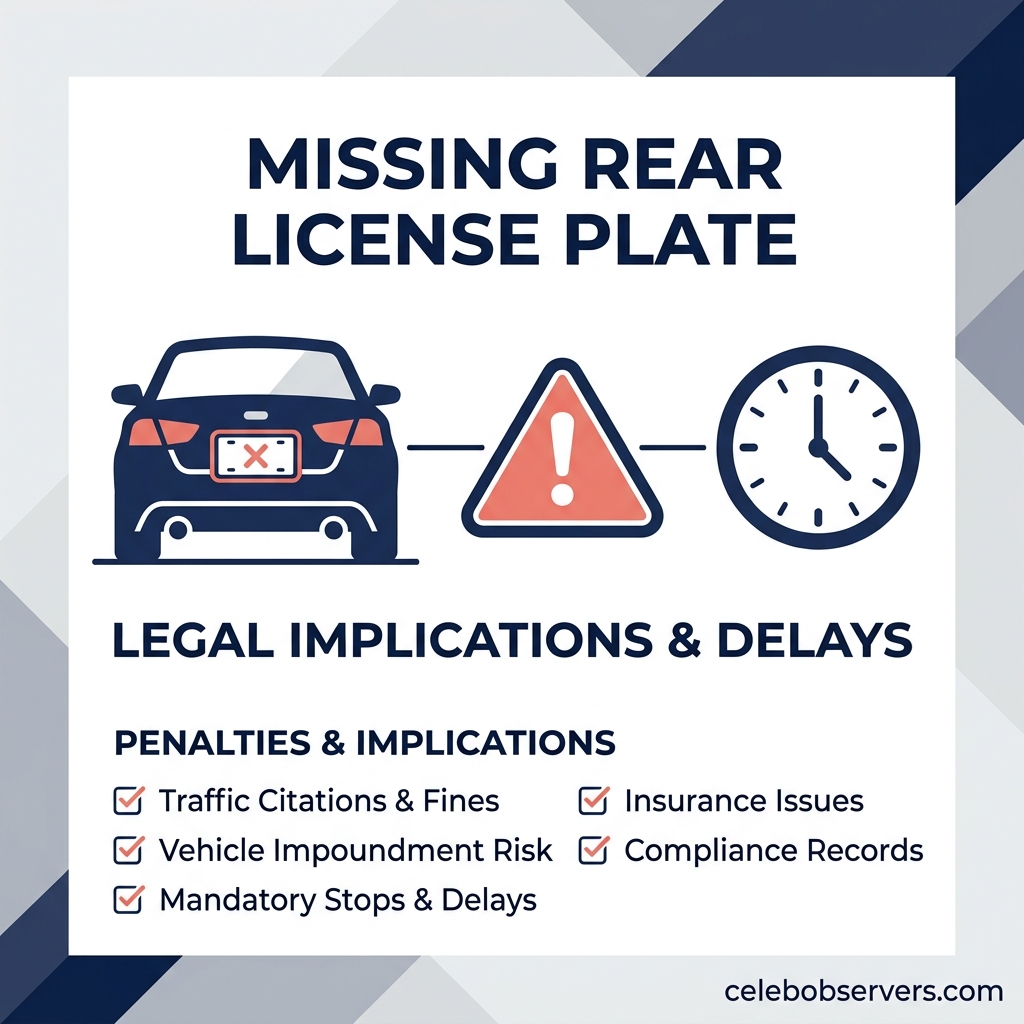
Here’s the part that catches people off guard. If your registration and remaining plate are still current, you may be able to keep driving with just the one plate temporarily while you wait for the replacement — but this depends heavily on your state. Some states are strict about requiring both a front and rear plate at all times. Driving without one, even temporarily, can get you pulled over and cited.
Ask your DMV directly whether they issue a temporary printout, temporary plate, or paper permit while you wait for the physical replacement. Many do, specifically for this scenario, and it’s usually free or low-cost. Don’t just assume you’re covered. Ask.
Common Mistakes People Make
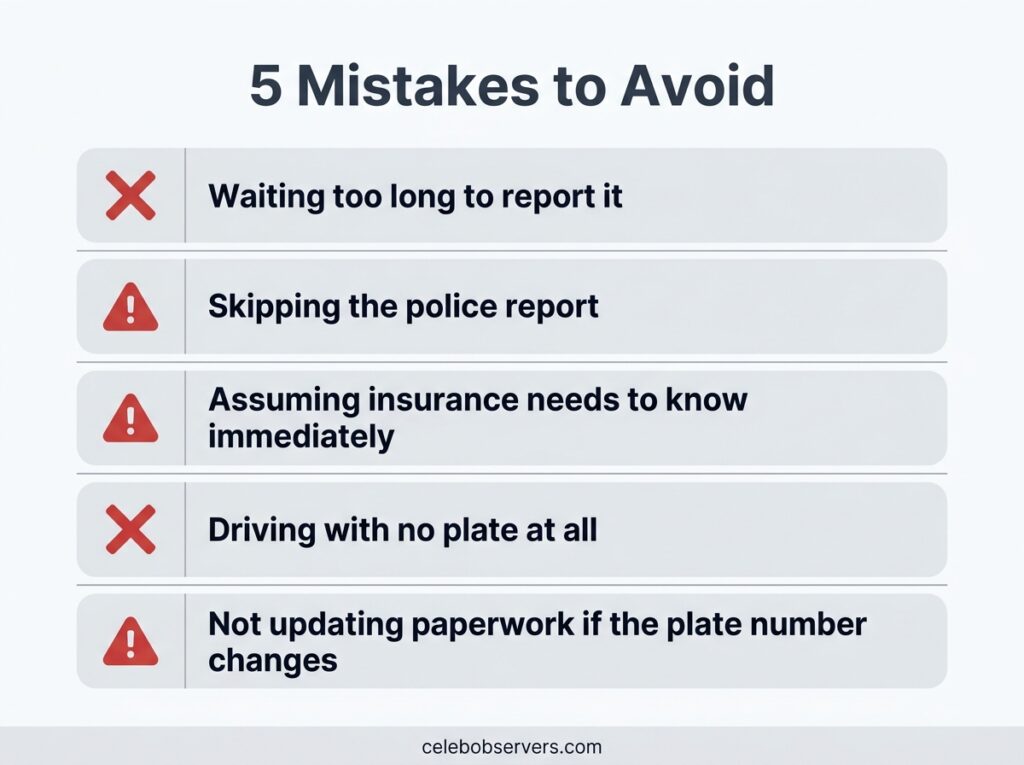
Waiting too long to report it. The longer a lost or stolen plate sits unreported, the more exposure you have if it’s used for fraud or ends up on another vehicle. Report it the same day you notice it’s gone, or as close to it as you can manage.
Skipping the police report because “it’s just a plate.” I get it — filing a report feels like overkill for a piece of metal. But if that plate gets used in a hit-and-run, a toll violation, or worse, and there’s no report showing you flagged it missing beforehand, you’re the one who has to prove it wasn’t you. That’s a much bigger headache than the ten minutes it takes to file online.
Assuming your insurance needs to know immediately. Losing a plate itself usually isn’t an insurance event — it’s not damage to the vehicle. But it’s worth a quick call or a check of your policy just in case your state or insurer has any reporting requirement tied to it, especially if a related incident, like a hit-and-run that knocked the plate off, is involved.
Driving around without any plate at all “just until the new one comes.” Genuinely risky. Being pulled over with a missing plate — even with a good excuse — can result in a citation in a lot of states, and it flags your vehicle for extra scrutiny. Get the temporary documentation if your state offers it.
Not updating registration paperwork if the plate number changes. If your state reissues you a completely new plate number rather than replacing the same one, your registration, insurance card, and even things like toll transponders or parking permits tied to your old plate number need to be updated. People forget this constantly, then wonder why their toll account isn’t recognizing their car anymore. This one trips up more people than you’d think.
Assuming all states handle this the same way. They don’t. Some states let you swap a plate for a small fee online in about a week. Others require an in-person DMV visit with a wait that stretches over a month while a new plate gets manufactured and mailed. Don’t plan your week around what you read on a forum from someone in a different state.
What It Costs and How Long It Takes
I’m not going to throw out a number that might be wrong for your state, or outdated by the time you read this. Replacement plate fees and processing times genuinely vary — not just state to state, but sometimes county to county depending on how the local DMV office operates. These numbers shift over time too, as state budgets and fee schedules change.
Here’s what tends to affect the cost and timeline, and how to find your actual numbers.
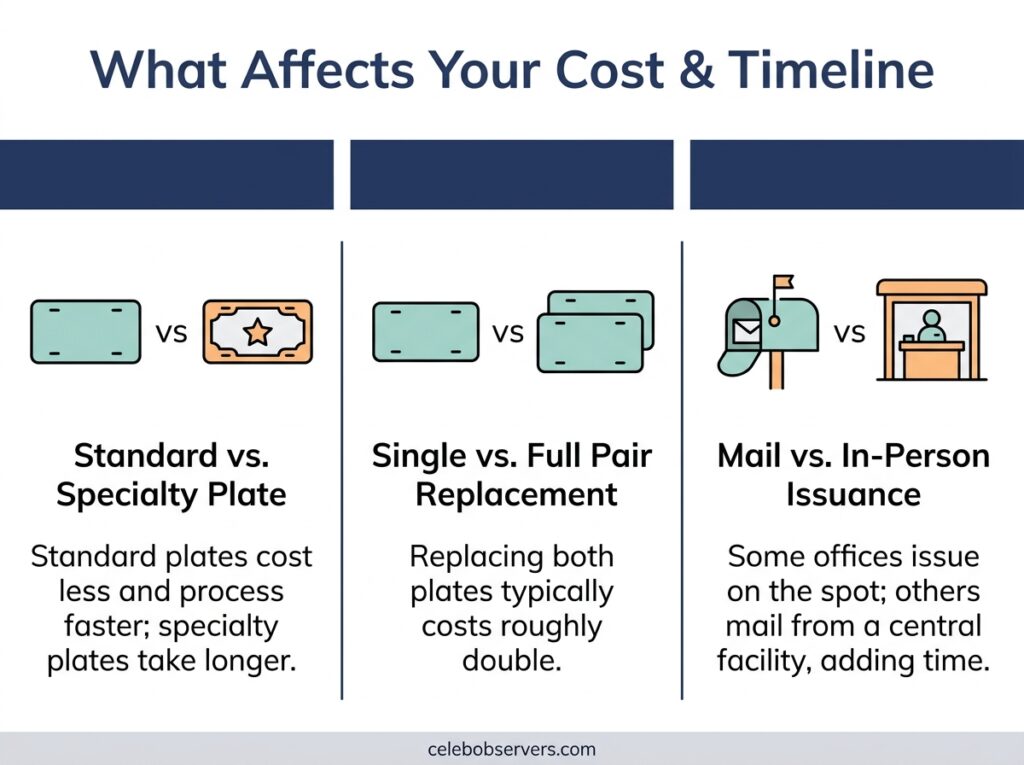
Standard plate vs. specialty plate. A basic state-issued plate replacement is typically the cheapest and fastest option. Specialty plates — military, university, personalized, organization-branded — often cost more to replace and can take longer, because they’re manufactured in smaller batches or require additional verification.
Single plate vs. full pair replacement. If your state requires replacing both plates as a set rather than just the missing one, expect the fee to run roughly double. Still varies by state.
Mail processing vs. in-person issuance. Some DMV offices can print a temporary plate or documentation on the spot. Others mail the physical plate from a central manufacturing facility, which adds time. If you’re in a rush, ask specifically whether same-day, in-office issuance is an option where you live. Some states offer it, others don’t.
How to find your exact number: go to your state DMV’s official website — not a third-party site pretending to be the DMV, that’s a common scam pattern people fall for — and search “replacement plate fee” or “lost plate application.” The fee schedule is almost always published there, along with estimated processing times. Not listed clearly? Call your local DMV office directly. Fastest way to get an accurate number instead of guessing off outdated forum posts.
One thing worth checking while you’re at it: whether your state offers expedited processing for an extra fee. If you drive for work, or genuinely can’t be without a legal plate for weeks, that upcharge is often worth it.
FAQ
Can I just make a temporary plate myself while I wait?
No. Making your own plate, or printing something that mimics an official one, is illegal in every state and will get you cited — often for something more serious than a missing plate violation. If you need to drive legally while waiting, get an official temporary permit or documentation from your DMV. This is exactly the kind of situation those permits exist for.
What if I find my old plate after I’ve already gotten a replacement?
Generally, you can’t use it. Once a replacement’s been issued and the old number’s flagged in the system, your registration is tied to the new plate. Check with your DMV about proper disposal — some states want you to destroy it or return it, since an old plate number floating around unused can still theoretically be misused.
Do I need to tell my insurance company if my plate is lost, but not stolen?
Typically, no — if it’s simply a plate that fell off with no accident or incident involved, that’s not damage to your vehicle. But if the plate went missing as part of a larger incident, like theft from your car, a hit-and-run, or vandalism, it’s worth a quick call to your insurer since that may be relevant to a claim.
Will a lost plate show up as a red flag if I get pulled over before I’ve replaced it?
It can, especially if you’re driving with only one plate in a state that requires two, or with no plate at all. This is exactly why filing your police report and DMV report promptly matters. If an officer runs your plate or VIN and sees an active report of a missing plate on file, it explains the situation instead of raising suspicion. Carrying a copy of your police report and DMV confirmation in your car during this window isn’t a bad idea.
The Bottom Line
Losing a plate feels like a bigger crisis than it usually turns out to be, as long as you handle it in the right order. Check the immediate area first. File a police report if theft is even a possibility. Report it to your DMV, apply for the replacement, and ask about a temporary permit if you need to drive before the new plate arrives.
The part people mess up most isn’t the DMV paperwork — it’s skipping the police report, or waiting too long to report it at all. Both can leave you exposed if that plate number gets misused while it’s out there unaccounted for. Handle it promptly, verify the specifics with your own state DMV rather than assuming your neighbor’s experience applies to you, and you’ll be back to a fully plated, fully legal vehicle within a reasonable stretch of time.